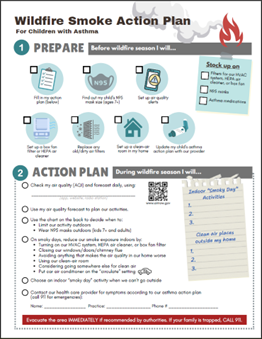
What is the Wildfire Smoke Action Plan for Children with Asthma (WFS-AP)?
The WFS-AP is a tool designed to empower parents and other caregivers of children with asthma protect their child from the harmful effects of wildfire smoke. It contains a list of actions to take before wildfire smoke season hits, and what to do when smoke rolls in. There are places on the Action Plan for caregivers to write in personalized ideas about how they can use the plan in a way that works for their families.
The Action Plan is accompanied by a Caregiver Toolkit, which contains more information on specific parts of the plan. The toolkit can serve both as educational tool and as a resource for families to consult later.
How do you use the WFS-AP?
The WFS-AP was designed for a community educator or healthcare provider to walk through the plan with a family, providing education and advice along the way. We think the plan would most feasibly be used by a nurse with some experience with asthma, or by an asthma educator. That being said, other individuals such as primary care physicians, community health workers, or other health educators may feel comfortable using the plan.
The plan could also be self-guided by caregivers, using the Caregiver Toolkit as a resource. In the future we hope to develop a guide to assist caregivers in using the plan on their own.
We recommend that those who work through the plan with families have some background knowledge in both childhood asthma and wildfire smoke, in order to be able to answer questions that come up. Here are several resources that we recommend for those needing more education.
Asthma education:
- The American Lung Association Asthma Basics course
- The King County Asthma Program asthma education modules
Wildfire smoke and health:
- NW PEHSU Wildfire Smoke and Children's Health: What Nurses Need to Know webinar
- US EPA Wildfire Smoke and Your Patient's Health web course (note that this course is not pediatric-focused)
For additional reading:
- Wildfire Smoke and Pediatric Lung Health: What the Clinician Needs to Know
- Health effects of wildfire smoke in children and public health tools: a narrative review
We are currently developing a training video which will walk healthcare providers and educators through how to share the Action Plan with families. Check back here for updates!
Ideally, sharing the WFS-AP will be accompanied by providing families with supplies, such as HEPA air cleaners or low-cost box fan filters (see the Caregiver Toolkit for how to make one), replacement filters, and N95 masks. If this is not possible, we strongly recommend looking for other resources within your community to help families obtain these supplies. Families frequently cite the cost of these supplies as significant barrier.
Why was the WFS-AP created?
Wildfires are becoming more common every year due to climate change. Fires have historically been common along the west coast of the United States and Canada, and the frequency and size of fires here and elsewhere has increased over time. Smoke from these fires can also travel hundreds or even thousands of miles, impacting people far from the site of the fire.
The smoke from fires increases people’s risk for a variety of health issues, including cough and throat irritation, asthma attacks, respiratory infection, heart attacks, preterm birth, anxiety, and depression. Children are especially susceptible to the respiratory effects of smoke due to their developing lungs. Children with asthma that are exposed to smoke are more likely to have asthma symptoms and exacerbations that require medical care. Recent research suggests that smoke also plays a role in developing asthma in the first place, and contributes to decreased lung function over the long term.
There are many evidence-based strategies to reduce personal smoke exposure, but not all families are aware of the recommendations or have the means to put them into action. Individuals who are racial or ethnic minorities or lower income both experience more smoke exposure and have a harder time protecting themselves from smoke, creating a health disparity. The WFS-AP is meant to overcome these barriers by helping families understand the health risks of smoke, and equip them with concrete steps and supplies to put recommendations into action in a way that works for their family.
How was the WFS-AP developed?
We created the first draft of the Action Plan based on public health guidance from the US Centers for Disease Control, Environmental Protection Agency, and American Academy of Pediatrics, along with generous advice from the creators of the Wildfire Smoke and Extreme Heat Action Plan at the Centre for Airway Health in British Columbia. Early drafts were reviewed by a variety of content experts, including general pediatric and pediatric pulmonary healthcare providers, public health practitioners, environmental scientists. We also interviewed caregivers of children with asthma in Washington State in order to understand their challenges and most urgent needs when protecting their child from smoke. Feedback from all of these individuals led to revisions of the tool.
We theorized that the Action Plan would work especially well in a pediatric primary care or pulmonary clinic setting, based on its relevance to child preventive care and asthma care. Knowing that pediatric nurses are excellent communicators and educators, we considered that they would be ideally positioned to share the Action Plan with families. To find out if this was true, we interviewed pediatric nurses from around Washington to learn their opinions of the tool and its feasibility. Their feedback confirmed that the tool was a good fit for the nursing scope of practice. We used their feedback to further improve the Action Plan to arrive at a tool more likely to be feasible for use in a clinic setting.
After finalizing the Action Plan, the content was professionally translated into Spanish. The translation was then iteratively reviewed and revised by a group of 3 bilingual individuals with expertise in public health.
Acknowledgements
We are very grateful to Dr. Emily Brigham of the University of British Columbia and her team at the Centre for Lung Health for their advice as we developed the Action Plan. We are also very appreciative of the time and energy of our caregiver and nurse interview participants.
The development of the WFS-AP was supported by the UW Pediatric and Reproductive Environmental Health Scholars K12 program (NIH K12ES033584) and the Northwest Pediatric Environmental Health Specialty Units.
Contact Us
If you would like to learn more, give us feedback, or partner with us on work related to the WFS-AP, please contact Dr. Mary Crocker at mary.crocker@seattlechildrens.org.
Last updated: February 10, 2026